

Triple-Negative Breast Cancer: Symptoms, Risks & Treatment
“Triple-negative” can sound like three things have gone wrong at once. But in breast cancer, the term means something more specific—and understanding what it means can change how the disease is treated.
When breast cancer cells are tested, doctors look for three important markers: estrogen receptors, progesterone receptors, and HER2 (Human Epidermal Growth Factor Receptor 2). In triple negative breast cancer, all three are absent. This means some commonly used breast cancer treatments are not suitable, but it does not mean that treatment options are unavailable.
For patients and families, the important questions are often more practical:
What symptoms should be noticed?
Who is at higher risk?
How is TNBC diagnosed?
What treatments can be considered?
Understanding these answers can help patients approach a diagnosis with greater clarity and make informed decisions with their cancer care team.
What Is Triple-Negative Breast Cancer?
Triple negative breast cancer is diagnosed when breast cancer cells test negative for:
- Estrogen receptors (ER)
- Progesterone receptors (PR)
- HER2 protein
These three markers are routinely assessed after a breast biopsy because they help doctors determine the type of breast cancer and select appropriate treatment.
Because TNBC does not rely on these three targets, hormone therapy and standard HER2-targeted treatments are not useful. Instead, treatment is usually based on the cancer’s stage, size, lymph node involvement, overall health, genetic findings, and other tumour characteristics.
Triple-Negative Breast Cancer Symptoms to Watch For
The triple negative breast cancer symptoms are generally similar to symptoms of other breast cancers. Some patients may have no noticeable symptoms and may discover the cancer during a screening mammogram.
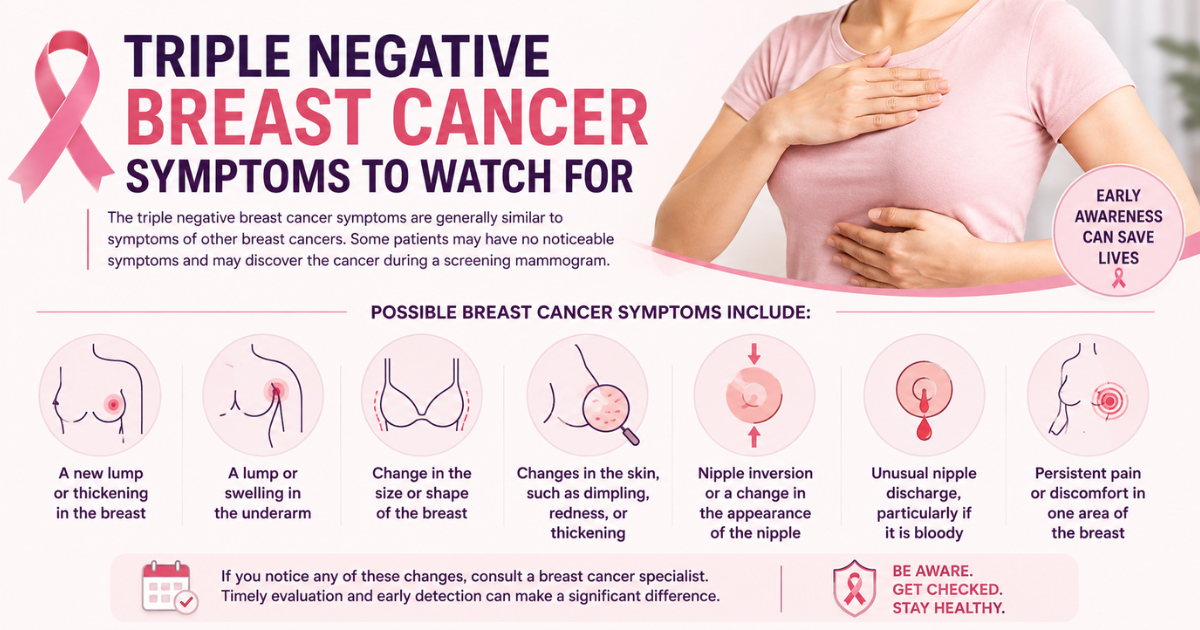
These symptoms do not automatically mean cancer. Many breast changes are caused by benign conditions. However, any new or persistent breast change should be evaluated by a healthcare professional rather than self-diagnosed.
What Increases the Risk of TNBC?
The exact reason why one person develops TNBC while another does not is not always known. Certain factors, however, are associated with a higher likelihood of developing this type of breast cancer.
Important risk factors include:
- A strong family history of breast or ovarian cancer
- Inherited mutations in genes such as BRCA1
- Being diagnosed with breast cancer at a younger age
- Certain population-related patterns, including a higher incidence among Black women
- A previous history of breast cancer
Having a risk factor does not mean that a person will develop TNBC. Similarly, someone without an obvious risk factor can still develop it.
If several close relatives have had breast or ovarian cancer, discussing genetic counselling and testing with a breast cancer specialist may be appropriate.
When Should You See a Doctor?
Do not wait for breast pain or a large lump before seeking medical advice.
You should consult a doctor if you notice a new breast lump, persistent thickening, nipple changes, unusual discharge, skin changes, or swelling in the underarm. Even when a change appears small, timely evaluation can help determine whether it is benign or requires further investigation.
Women who are at increased genetic or familial risk may also need a personalised screening plan rather than relying only on routine screening recommendations.
How Is Triple-Negative Breast Cancer Diagnosed?
A breast cancer diagnosis usually involves several steps.
| Clinical examination and breast imaging | A doctor may examine the breast and underarm and recommend imaging such as mammography, ultrasound, or, when appropriate, breast MRI. |
|---|---|
| Breast biopsy | If imaging identifies a suspicious area, a biopsy may be performed. During a biopsy, a small tissue sample is removed and examined under a microscope to determine whether cancer cells are present. |
| Receptor and biomarker testing | Once breast cancer is confirmed, the tissue is tested for ER, PR, and HER2. TNBC is identified when all three are negative. Additional tests may be recommended depending on the patient’s situation, including PD-L1 testing and genetic testing for inherited BRCA1 or BRCA2 mutations. |
These results help the oncology team determine the most appropriate treatment strategy.
Triple-Negative Breast Cancer Treatment
The triple negative breast cancer treatment plan depends heavily on the stage and characteristics of the cancer. Treatment may involve more than one approach.
Chemotherapy
Chemotherapy for breast cancer remains an important part of treatment for TNBC. For many patients with stage I–III disease, chemotherapy may be given before surgery to reduce the size of the tumour and treat cancer cells that may have travelled beyond the breast.
Giving treatment before surgery is known as neoadjuvant therapy. It can also provide doctors with information about how effectively the cancer responds to treatment.
Immunotherapy
Immunotherapy has expanded treatment options for some patients with TNBC. Immunotherapy for TNBC, particularly pembrolizumab, may be combined with chemotherapy before surgery in appropriate patients with early-stage, higher-risk disease and may continue after surgery.
For advanced TNBC, pembrolizumab may also be considered in selected patients whose tumours have sufficient PD-L1 expression. The suitability of immunotherapy depends on factors such as disease stage, biomarker results, previous treatment, and overall health.
Breast Cancer Surgery
After systemic treatment, surgery may be recommended when the cancer can be removed.
Depending on the tumour’s size, location, breast size, and other factors, options may include:
- Lumpectomy, which removes the tumour along with a margin of surrounding healthy tissue
- Mastectomy, which removes the entire breast
Nearby lymph nodes may also be evaluated or removed when necessary.
Radiation Therapy
Radiation therapy may be recommended after surgery based on the tumour size, lymph node involvement, surgical margins, and other risk factors. Its purpose is to reduce the risk of cancer returning in the treated area.
Targeted Treatment for Selected Patients
Some patients with inherited BRCA1 or BRCA2 mutations may benefit from targeted treatment such as olaparib after chemotherapy and surgery when they meet the appropriate clinical criteria.
For advanced or metastatic TNBC, additional treatments may include antibody-drug conjugates such as sacituzumab govitecan, depending on previous treatments, tumour characteristics, eligibility, and regulatory availability. Treatment choices for advanced TNBC continue to evolve.
Can Triple-Negative Breast Cancer Be Prevented?
There is no guaranteed way to prevent TNBC, particularly when inherited genetic factors are involved. However, maintaining overall health and following appropriate breast cancer screening recommendations can support early detection and general cancer risk reduction.

For women with inherited high-risk genetic mutations, doctors may recommend more intensive surveillance or risk-reduction strategies.
Why Early Diagnosis and Specialist Care Matter
TNBC can behave more aggressively than some other breast cancer subtypes, making timely diagnosis and appropriate treatment particularly important. At the same time, a diagnosis of TNBC does not mean that treatment options are limited. Advances in chemotherapy, immunotherapy, targeted treatment, and personalised cancer care have expanded the choices available to patients.
A multidisciplinary approach can be especially valuable. A team may include a breast cancer specialist, breast surgeon, medical oncologist, radiation oncologist, radiologist, pathologist, genetic counsellor, and other supportive-care professionals. Reviewing the diagnosis collectively helps ensure that treatment decisions consider the cancer’s stage, biomarkers, genetic findings, and the patient’s individual needs.
Conclusion
Triple-negative breast cancer requires careful diagnosis and an individualised treatment plan, but advances in cancer care have expanded treatment options for eligible patients. Recognising triple negative breast cancer symptoms, following recommended screening, and seeking medical evaluation for persistent breast changes can support timely diagnosis and appropriate treatment.
At Omega Hospitals, breast cancer care is supported by a multidisciplinary team of breast surgeons, medical oncologists, radiation oncologists, radiologists, pathologists, and other specialists. This coordinated approach helps patients receive personalised care based on the type, stage, and specific characteristics of their cancer.
If you notice a new breast lump, nipple or skin change, unusual discharge, or another persistent breast change, consult a qualified healthcare professional or breast cancer specialist for appropriate evaluation and timely care.